
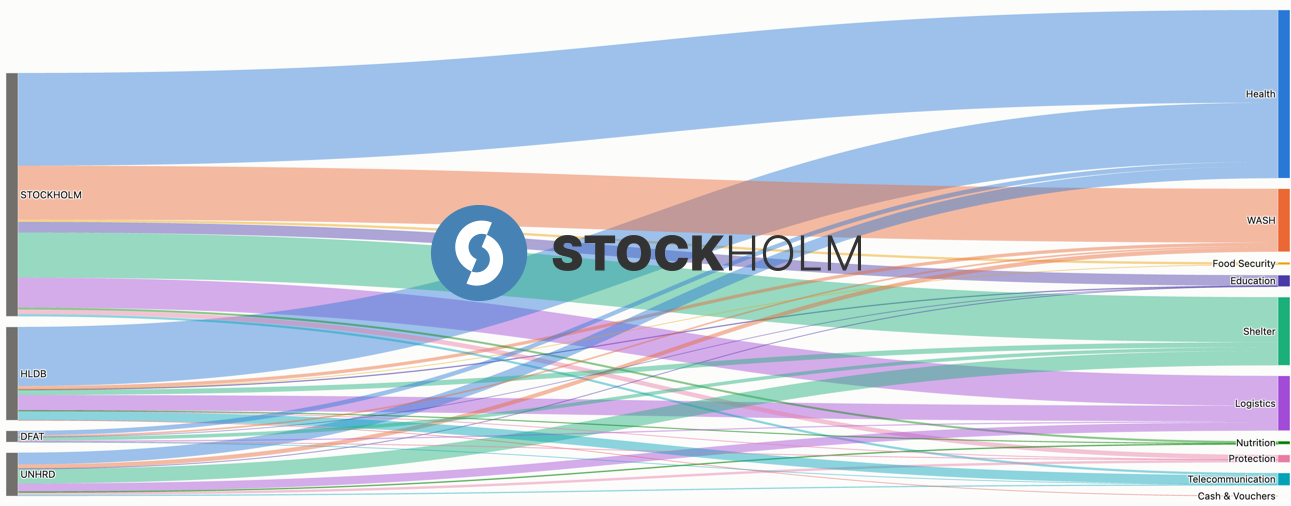
Behind the Scenes is a new ESUPS series opening up the work involved in developing and maintaining the STOCKHOLM platform. Through interviews and technical stories, it introduces the people behind the platform and explains the decisions shaping its development.
Interested in stock prepositioning?
Subscribe to the ESUPS newsletter and stay updated on all things related to stock prepositioning.
STOCKHOLM provides humanitarian actors with a visual overview of prepositioned relief stocks and tools to analyse them collectively. As Martin Keitsch explained in the first edition of the series, the platform’s core idea is to unify and find common denominators that make stock data from different organisations genuinely comparable.
In March 2026, ESUPS began a detailed review of STOCKHOLM’s stock data, led by Tania Ochoa, an external consultant with a strong background in large-scale data analysis in supply chain and logistics.
“My role is to analyse the data in the platform, identify gaps or inconsistencies, correct them and propose preventive actions for the long term. The objective is not only an immediate correction, but to minimise the chance of the same problem happening again”, Tania Ochoa.
Initially working closely with Lila Ricart, she completed a comprehensive review of 9,343 stock records across 72 organisations, the largest data reviews STOCKHOLM has carried out. She began by examining the stocks partners had registered and how their descriptions, classifications and units of measure aligned with STOCKHOLM’s structure.
This required an understanding of organisations’ logistics practices and a strong background in interpreting stock data, drawing on her experience in humanitarian logistics with the Logistics Cluster and the Norwegian Refugee Council and across production planning, procurement and logistics in the private sector.
The process resulted in the review and resolution of all flagged records, improving the overall consistency and reliability of the platform’s stock data and providing a stronger foundation for future analysis and reporting.
“We will need to take a fresh look and review whether the structure we have defined continues to fit what partners are uploading into the system, and whether there are additional changes we need to make”, Tania Ochoa.
What is an item group?
Later, as Martin Keitsch joined the team as Technical Manager, Tania Ochoa helped refine the item group structure in the STOCKHOLM platform.
In STOCKHOLM, an item group brings together disaster relief items with the same operational use. It is a logical grouping of stock from different organisations into one consolidated, countable group, providing a common reference for stock recorded under different names, codes or languages.
The structure connects individual item descriptions to item groups, which sit within ten humanitarian clusters. Each group has a defined scope and unit of measure, helping ensure that the quantities brought together have a consistent operational meaning.
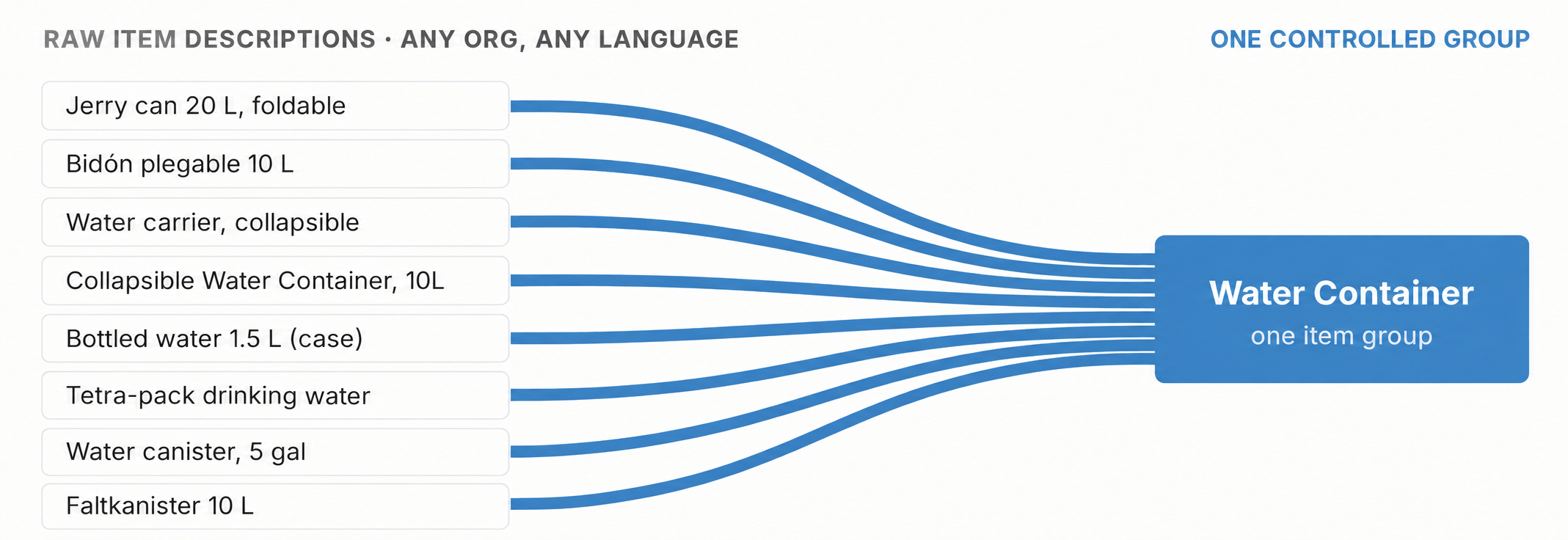
To refine this structure, the team benchmarked STOCKHOLM’s initial classification against the major relief-item datasets and standards. These included the catalogues from UNHRD, DFAT, Save the Children, HDX, IFRC, Sphere and Dubai Humanitarian Logistics Databank. Together, the sources provided 5,917 unique item descriptions that were grouped in 78 item groups. The changes become clearer through concrete examples, see below:
- Health: the review distinguished medical stock by form, not function, grouping stock data into injectable medicines, medical kits and equipment, and medical devices and supplies.
- WASH: what was previously classified as “Water Distribution and Storage” category was reorganised by function, distinguishing water systems and tanks, individual water components, bottled and packaged water, and water treatment and desalination supplies.
- Shelter: the household category was unpacked into more specific groups, including individual household items, clothes, kitchen sets, stoves and cooking fuel, and shelter tool kits.
Tania’s detailed examination of STOCKHOLM’s records informed this work, while Martin helped consolidate the structure and develop rules for matching item descriptions to groups. The resulting item group classification can be found in our User Guides.

Conclusion
As an active member of the Digitalisation Workstream of the Humanitarian Leadership Group on Supply Chain (HLGSC), ESUPS is bringing concrete evidence from STOCKHOLM to the discussions of the group by testing standardised classifications and documenting inconsistencies.
“Data quality is not a challenge faced by STOCKHOLM alone. The lessons from this revision can contribute to the HLGSC Digitalisation Workstream and support the sector’s progress towards common data standards and shared practices”, Florent Chane, ESUPS Project Manager
Photo: World Economic Forum/Thibaut Bouvier
This is the second article in the Behind the Scenes series, where we share the work that goes into keeping STOCKHOLM’s data accurate and the platform reliable for the organisations that depend on it. By opening up these processes we hope to be transparent about the platform’s ongoing development goals. More editions will follow, stay tuned!
AI disclosure: This article was drafted with support of Artificial Intelligence, including this disclosure. We began by interviewing team members, gathering documentation about the work described and developing a structure for the article. We then uploaded all these materials into two AI tools to support drafting. Finally, we combined their outputs and reviewed it against the sources. The ESUPS team takes responsibility for the final content.